
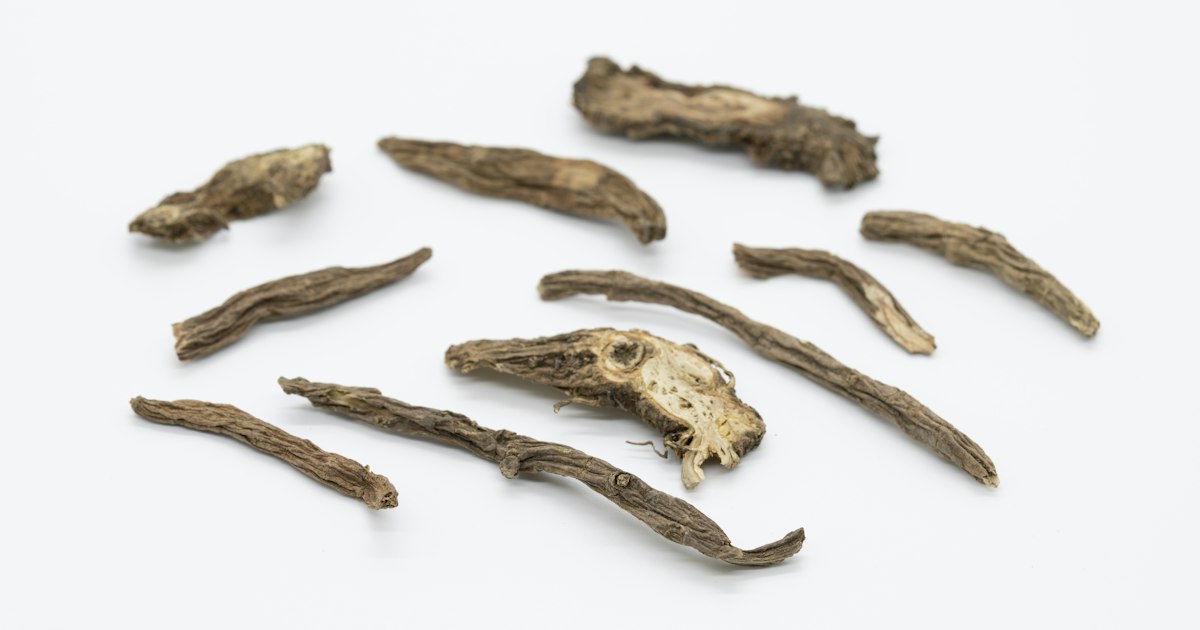
Tongkat ali is a herbal dietary supplement, so it is possible to give practical guidelines for taking it. However, efficacy and safety are highly dependent on the type of extract, dose, and duration. The editors have collected dosages from clinical studies and explain how to choose the time of reception, how long the course lasts and whether breaks are needed.
First, the type of extract
All clinical studies on which the guidelines are based used standardized aqueous extracts of tongkat ali root. Such extracts are concentrated and standardized according to marker substances — primarily eurycomanone. Therefore, the given doses refer to them, and not to the raw powder of the root.
Notations such as "200:1" or "100:1" describe the ratio of raw materials to extract, but do not guarantee the content of active substances. Such numbers are often used in marketing to make a product appear "stronger". A more reliable guide is the indicated percentage of eurycomanone and the amount of extract in milligrams per serving.
The powder of the crushed root without extraction contains significantly less active substances, and there are practically no clinical data for it. It is difficult to reproduce the effects of studies with such a product.
If tongkat ali is part of a complex "booster", check exactly how many milligrams of extract are in a serving. Often, its amount is much lower than the studied doses, and the effect of the combination with other plants has not been studied.
Doses in clinical trials
Studies have used a range of 100 to 400 mg of standardized aqueous extract per day. The most common dose is 200 mg. Below are guidelines from the most frequently cited works.
| Research | Participants | Daily dose | Duration |
|---|---|---|---|
| Hamzah, Yusof 2003 | Men on strength training | 100 mg | 5 weeks |
| Tambi 2012 | Men with age-related hypogonadism | 200 mg | 1 month |
| Talbott 2013 | Adults with moderate stress | 200 mg | 4 weeks |
| Ismail 2012 | Middle-aged men | 200 or 300 mg | 12 weeks |
| Henkel 2014 | Active older people | 400 mg | 5 weeks |
| Chen 2014 | Male athletes | 400 mg | 6 weeks |
Therefore, a practical guideline for an adult male is 200–400 mg of a standardized aqueous extract per day. Start sensibly on the lower end and assess tolerability, especially with possible insomnia and restlessness.
Advantages of doses higher than 400 mg have not been shown. On the other hand, with an increase in the dose, the probability of adverse reactions increases, and in the case of a low-quality product, the presence of impurities.
Tongkat ali has been studied much less in women, so there are no uniform recommendations. If a woman is considering taking it, it should be discussed with her doctor because of the potential effect on androgens.
When to take
Tongkat ali is often described as a remedy with a mild tonic effect, and some users complain of poor sleep when taken in the evening. Therefore, most manufacturers and practitioners advise taking the supplement in the first half of the day — in the morning or before lunch.
- the optimal time is in the morning, during breakfast;
- when dividing the dose into two doses, the second - no later than lunch;
- taking with food reduces the risk of stomach discomfort;
- there is no need to tie the reception to training.
The effects of tongkat ali described in studies develop over weeks of regular use, not hours. Therefore, it makes no sense to take it "before training" as a stimulant: it is more important to consistently adhere to the daily schedule.
There are no studies that would compare intake on an empty stomach with food. If your stomach is sensitive, take the supplement with a meal. There are no specific restrictions regarding the combination with coffee, but in sensitive people, the cumulative tonic effect can be felt.
Course duration and breaks
In the studies, the duration of reception was from four weeks to several months, the longest was about half a year in the work of Leitão et al. (2021). For most of the declared effects, the first changes were recorded after 4–6 weeks.
There is little data on the safety of continuous use for many months or years. Therefore, a common conservative practice is a 4-12 week course followed by a break to assess whether a difference is felt without the supplement.
Schemes such as "five days of reception - two days off" or "one week after another" are popular in the sports environment. They are explained by the desire to avoid "addiction", but there are no studies that would confirm the benefits of such schemes.
During long-term use, it is advisable to periodically check the complete blood count, liver tests and hormone profile, especially if you are taking a supplement for the purpose of correcting testosterone.
Combination with other additives and control of the effect
Tongkat ali is often combined with ashwagandha, zinc, magnesium, vitamin D, fadogia, or long-term. There are no known problematic interactions with basic minerals and vitamins. However, the effectiveness and safety of combinations of several herbal "boosters" have not been studied.
The more herbal extracts in a regimen, the more difficult it is to understand what works and what causes an adverse reaction. The editors advise introducing supplements one at a time, with an interval of several weeks.
If the goal is to maintain testosterone, it is more objective to evaluate the effect by tests, and not by feelings. It is reasonable to take total and free testosterone, LH and SHBG before the start of the course and after 6–8 weeks, under the same conditions (in the morning, on an empty stomach).
Athletes undergoing doping control should choose only products with independent certification: the plant itself is not prohibited by WADA, but the risk of contamination in the booster category is high.
Editorial conclusion
An approximate dose is 200–400 mg of a standardized aqueous extract of the root per day, preferably in the morning with food.
The effect develops in 4–6 weeks of regular intake; a course of 4-12 weeks with a break corresponds to the available data. Popular schemes of "reception and rest days" have no scientific basis.
Product quality and analysis control are more important than the subtleties of the admission schedule.
We also recommend reading our articles "Side Effects of Tongkat Ali", "Benefits of Tongkat Ali for Athletes: Evidence Base" and "How to Take Ashwagandha: Dosage, Time of Administration, Duration".
References
- Hamzah S, Yusof A. The ergogenic effects of Eurycoma longifolia Jack: a pilot study. Br J Sports Med. 2003;37(5).
- Tambi MI, Imran MK, Henkel RR. Standardised water-soluble extract of Eurycoma longifolia, Tongkat ali, as testosterone booster for managing men with late-onset hypogonadism? Andrologia. 2012;44 Suppl 1:226â230.
- Talbott SM, Talbott JA, George A, Pugh M. Effect of Tongkat Ali on stress hormones and psychological mood state in moderately stressed subjects. J Int Soc Sports Nutr. 2013;10(1):28.
- Ismail SB, Wan Mohammad WM, George A, et al. Randomized clinical trial on the use of PHYSTA freeze-dried water extract of Eurycoma longifolia for the improvement of quality of life and sexual well-being in men. Evid Based Complement Alternat Med. 2012;2012:429268.
- Henkel RR, Wang R, Bassett SH, et al. Tongkat Ali as a potential herbal supplement for physically active male and female seniors â a pilot study. Phytother Res. 2014;28(4):544â550.
- Chen CK, Mohamad WM, Ooi FK, Ismail SB, Abdullah MR, George A. Supplementation of Eurycoma longifolia Jack extract for 6 weeks does not affect urinary testosterone: epitestosterone ratio, liver and renal functions in male recreational athletes. Int J Prev Med. 2014;5(6):728â733.
- Leitão AE, Vieira MCS, Pelegrini A, da Silva EL, Guimarães ACA. A 6-month, double-blind, placebo-controlled, randomized trial to evaluate the effect of Eurycoma longifolia (Tongkat Ali) and concurrent training on erectile function and testosterone levels in androgen deficiency of aging males (ADAM). Maturitas. 2021;145:78â85.